Library History 1901-1913
The Carnegie Library
Carnegie libraries were appearing all over the country at the turn of the last century. Negotiations with the Carnegie Corporation for a library in Monroe County began on March 15, 1901, and a pledge of $15,000 was received later that year on December 21. Five days later, the matter was given to the Commercial Club 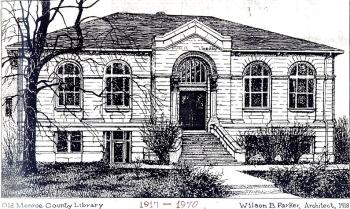 to work on getting community support for a library levy. By July 1902 there had still been no agreement on the necessary tax. Consequently, the question of accepting a construction grant from the Carnegie Corporation was postponed for more than a decade.E. M. C. Hobbs, president of the Library Board, re-established contact with the Carnegie Corporation in 1913. According to the Bloomington Weekly Courier of April 2, the library board planned to bid $12,000 the following Saturday on a lot at 6th and Washington St., which had formerly been occupied by a school for "colored" persons, and before that had been a township school. On November 7, 1913, Carnegie sent another offer to the city of Bloomington for $27,500. In a letter dated April 7, 1915, Mr. Hobbs stated that the lot was purchased for $12,000. The next several months were spent trying to secure a larger grant amount to construct a finer building. These efforts were rewarded on September 29, 1915, with the promise of $31,000 from the Carnegie Corporation. Wilson B. Parker of Indianapolis was hired as the architect for the project. An objection to the blueprints, especially for a lecture room in the basement, delayed approval of the plans until April 4, 1917. Dedicated February 1, 1918, the facility opened with Miss Catherine C. Ashman as librarian over a collection of 6,300 volumes.This structure remained the library's home until a new facility was constructed in 1970. The former Carnegie Library Building is now on the National Register of Historic Places. It currently houses the Monroe County History Center and the Genealogy Library.